
Category: Reference Based Pricing 101

  • FairPrice Examines the Future of RBP

    FairPrice Examines the Future of RBP

    Reference-based pricing (RBP) has potential to revolutionize the way Americans handle healthcare.

    [blockquote]It’s a system that puts patients back in the driver’s seat. Patients will control the decisions made for care and for the pricing of those healthcare choices. [/blockquote]

    Reference-Based Pricing has a Bright Future

    There are several things that RBP is set to do in the future including:

    • Increasing transparency in pricing costs. This could amount to tens, or even hundreds, of thousands of dollars
    • Better ability to discern costs relative to value; customers would be able to make this purchase like any other major purchase
    • Decreased cost of emergency services, due to more competitive pricing by healthcare facilities

    Why Use Medicare as a Reference?

    Medicare was signed into law in 1965 to provide a healthcare option for individuals who might not otherwise be able to afford healthcare. Medicare serves over 55 million people today. Medicare has price caps in place and enormous negotiating power with medical providers. This extraordinary pricing control should not be available to Medicare patients alone.

    [blockquote]With RBP, presented by FairPrice, it can be available to everyone. Often, this strategy can save employers as much as 30% on the cost of healthcare.[/blockquote]

    The “reference” for reference-based pricing is based on the relevant factors in the area. It can be a reference to the monetary amount that prevails in a given area for a specific service. It can also reference other available healthcare pricing schedules. Medicare is a strong reference point that makes negotiation simple.

    The End of Price Discrimination

    Price discrimination exists whenever sales of identical goods or services occur at different prices by the same supplier. Everyone has the right to equal pricing; especially when dealing with your health. RBP has the potential to spell the end of price discrimination in medical care. This valuable solution could make a big difference for your employees and your business. Don’t drain your budget due to the rising cost of healthcare. Instead, consider RBP, presented by FairPrice, for your employees and watch the face of healthcare transform.

    If you’re ready to make a decision right now, or if you’d like more information, schedule a 15-minute call with FairPrice.

    FairPrice is the new, patient-first way forward. It utilizes Reference Based Pricing as part of its online insurance community. This community is built to provide coverage and transparent pricing. We give patients direct access to the doctors and hospitals that are known for quality care. Patients choose their provider based on what they’re willing to pay—full transparency. No hidden markups—just true prices.


  • Pros and Cons of Reference-Based Pricing

    Pros and Cons of Reference-Based Pricing

    Is Reference-Based Pricing Right for My Business?

    If you’re considering Reference-Based Pricing (RBP) for your business, a hard look at both the advantages and disadvantages is in order. You want to make sure you’re making the best possible choice for yourself and for your employees.

    Advantages of Reference-Based Pricing

    The advantages of RBP are clear:

    • Healthcare costs less—for everyone
    • Greater transparency, making it possible to compare unit costs
    • Broaden or restrict your company’s available provider list based on the percentage of Medicare your plan pays
    • Better predict your health care expenditure in the future
    • It’s possible to normalize the price escalation of healthcare

    Disadvantages of Reference-Based Pricing

    Any major change comes with a few disadvantages. A clear look at the disadvantages of RBP will allow you to decide if it’s a workable solution for your business. Disadvantages include:

    • Not all providers and facilities take part in RBP
    • Employees may receive a balance bill if there was no pre-negotiated reference to Medicare established.
    • Consolidation of healthcare providers makes non-profit healthcare companies operate like non-profits

    Before you make a decision on RBP, it’s important that you understand the challenges you’ll face and the benefits that will go along with it.

    If you’re ready to make a decision right now, or if you’d like more information, schedule a 15-minute call with FairPrice.

    FairPrice is the new, patient-first way forward. It utilizes Reference Based Pricing as part of its online insurance community. This community is built to provide coverage and transparent pricing. We give patients direct access to the doctors and hospitals that are known for quality care. Patients choose their provider based on what they’re willing to pay—full transparency. No hidden markups—just true prices.

  • Transparency: What are Doctors Charging for Healthcare?

    Transparency: What are Doctors Charging for Healthcare?

    Here’s a hard truth that many physicians would rather not admit: all too often they don’t know what they’re charging you. They don’t know how much you pay, they don’t know how much your insurance pays, and they don’t know how billing is handled. When your doctor doesn’t know what you’re being charged, there’s something wrong with the system!

    Unfortunately, many doctors outsource their business functions. Doctors do not want to code or negotiate prices with each network, so they hand it over to someone else—and that means that you’re losing out.

    Healthcare Pricing By Law

    By law, doctors must offer the same list price to all of their patients. Unfortunately, the creation of PPOs, or discount programs, began as managed care networks. This means that they had a select list of providers for you to see that you controlled. Pricing is different for each PPO. This means that some patients are able to receive much lower costs than others.

    Most managed care network agreements (PPOs) are based on a discount off a billed charge. Billed charges bear little relationship to actual costs.

    Why Do Practices Negotiate Healthcare Costs?

    It all comes down to supply and demand. Doctors negotiate with insurance companies because insurance companies control access to patients.

    [blockquote]Like any other business, doctors need customers; thus, the phrase “being in-network” with an insurance company was born.[/blockquote]

    Are In-Network providers actually more expensive?

    In-network healthcare providers are the cause of the problem; insurance companies own the largest networks of providers. It’s assumed that they will give them the best discounts.

    The problem is this: you might have a variety of networks, but only one or two hospital systems to serve the area.

    [blockquote]Limited supply makes prices go up, and as a result, both insurance companies and healthcare providers make more.[/blockquote]

    How Do We Fight Rising Prices and the Lack of Transparency?

    At the end of the day, people are the ones who make a difference. If people are able to negotiate their own pricing relationships with providers, insurance companies no longer hold them in their power. Instead, millions of purchasers shift the tide creating a direct relationship with providers.

    Middlemen—in this case, the insurance companies—create more cost. End the need for the insurance company and you create benefits for your employees and your business.

    FairPrice removes the middleman. FairPrice is the new, patient-first way forward. It’s an online insurance community that’s built to provide coverage and transparent pricing. We give patients direct access to the doctors and hospitals that are known for quality care. Patients choose their provider based on what they’re willing to pay—full transparency. No hidden markups—just true prices.
  • Unsustainable Healthcare — and the Solution

    Unsustainable Healthcare — and the Solution

    Healthcare costs across America have become exorbitant. In some cases, a simple Aspirin can end up costing the person taking it as much as $400. Epipens—vital medication for individuals with allergies—cost $57 in 2007; now, a single pen costs $600 or more. The House of Representatives report on the top 10 generic drugs from 2013 to 2014 saw increases between 420% to 8,000%—in one single year!

    How Are Your Employees and Your Company Dealing with Rising Healthcare Costs?

    Many Americans find that the rising cost of healthcare destroys home budgets. The rising cost of healthcare also increases stress levels.

    [blockquote]Healthcare debt causes over 60% of the bankruptcies in America.[/blockquote] [blockquote]“89.62% of health benefit brokers are concerned with the rise in healthcare costs” – A recent Paylocity survey notes. [/blockquote]

    Payroll professionals and human resource departments are finding with the rise of the Affordable Care Act, costs are rising even higher. In 2015 alone, 82% of participants found that the ACA had already raised their care costs. It’s obvious that many Americans are struggling with the weight of rising care costs.

    [blockquote]Reference-based pricing (RBP) can provide the solution.[/blockquote]

    RBP provides fair medical pricing. This fair pricing makes it easier to discern the price of medical services. Under reference based pricing, insurance companies, medical providers and patients all win.

    Is America’s Healthcare Sustainable?

    If healthcare prices continue to rise consistently with the past three years—at an average rate of 6.1% per year—many American households will find themselves in a terrifying position.

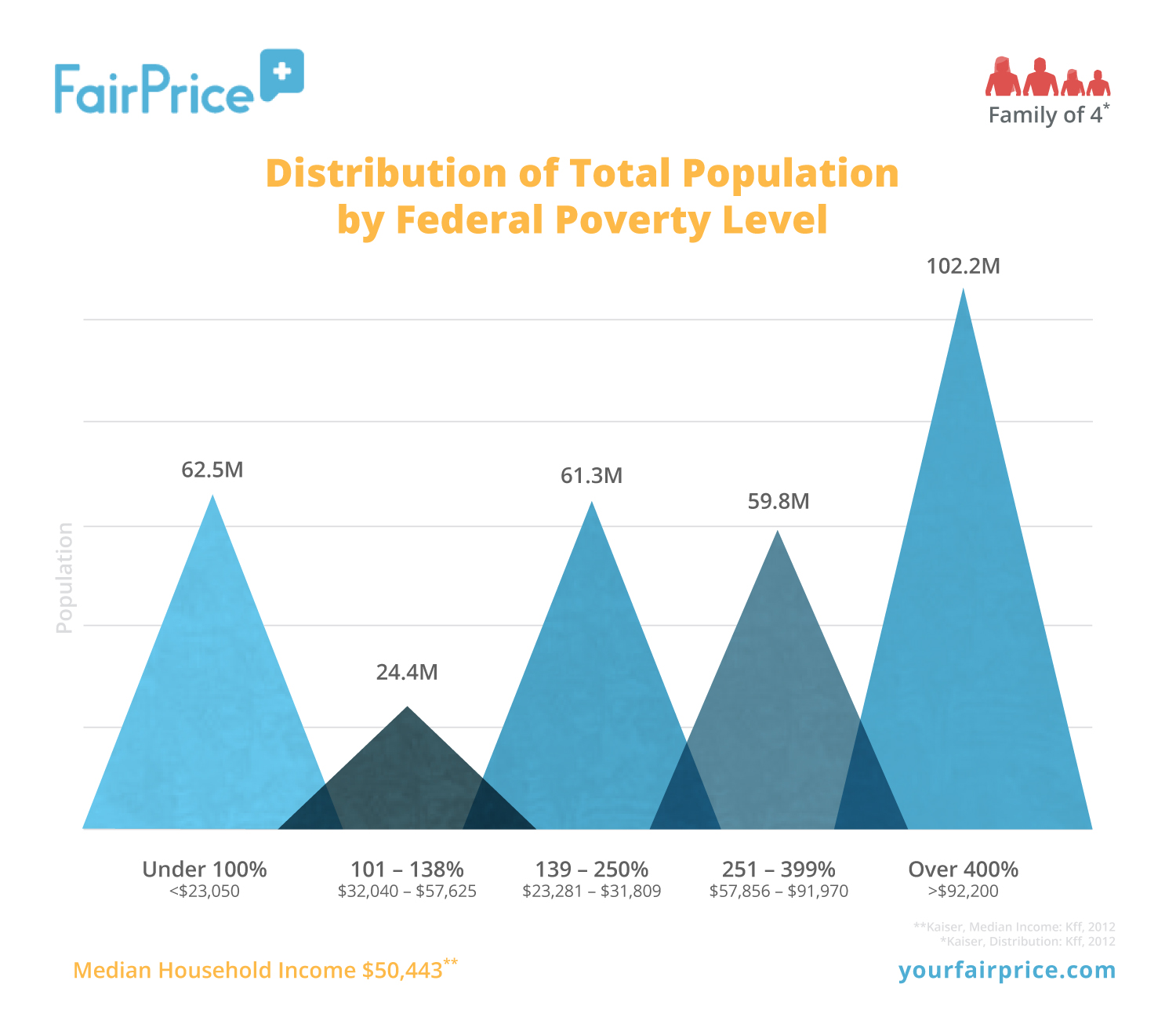
    By 2019, the average premium for American families will be approximately $24,180. At an 8.7% increase—the average number seen over the past 10 years—the average family premium could be as high as $30,803. For many families, this simply isn’t a sustainable rate!

    Take a look at the cost to income chart below. Note that as many as 87 million people live in households that make less than the projected cost of health insurance by 2019.

    The Distribition of Total Population by Federal Poverty Level in the USA Infographic 2017

    Median Household Income $50,443 (Kaiser, Median Income: Kff, 2012)

    Simply put, many Americans, by 2019, will not be able to afford the basic cost of insurance. Americans will also not be able to afford the high payments associated with medical care. Healthcare prices have doubled every ten years since 1965; America’s income hasn’t increased along with it.

    Fairness: A Basic Human Right

    Fairness in America is considered to be a basic human right. Unfortunately, when price discrimination comes into play in the healthcare system, it’s not fair for anyone. In America, prices are raised for a specific demographic while lower-priced alternatives are available to other populations.

    How Reference-Based Pricing helps America’s Healthcare Discrepancies

    With Reference-Based Pricing, you are put back in charge of your healthcare and the money you spend on healthcare. Suddenly, it becomes a sustainable proposition again—and many Americans will, for the first time in years, be able to afford the cost of sufficient care.

  • Reference-Based Pricing 101

    Reference-Based Pricing 101

    Reference-based pricing provides fair medical pricing, which makes it easier to discern the price of medical services. Under reference-based pricing, insurance companies, medical providers and patients all win.

    How Does Reference-Based Pricing Work?

    Reference-based pricing (RBP) works for everyone. Any company employee or patient is able to see any provider or facility that will accept them as a patient.

    [blockquote]Patients aren’t limited by in-network providers or by a specific list of providers. [/blockquote]

    Who pays the claim in Reference-Based Pricing?

    When a claim is submitted, the health plan administrator will pay the claim for the services on behalf of the plan sponsor (the employer). Like a traditional insurance plan, this is the full amount of coverage minus any coinsurance, copays, or deductibles.

    What is the fee schedule for Reference-Based Pricing?

    Reference-based pricing is based on a reference to Medicare and other fee schedules. The Medicare schedule is the baseline for medical services received by the patient.

    Frequently Asked Questions

    Q: What if an employee is denied access to a specific provider because they don’t have a network attached to their plan?

    A: Employees are able to access another facility or help is provided with their chosen facility.

    Q: What if a provider hasn’t agreed to a reference to Medicare payment as fair and reasonable?

    A: If a provider hasn’t agreed to a Medicare reference as fair payment, they can bill the patient for the remaining amount of the cost of services.

    Q: What is an employee supposed to do if they receive a balance bill from the provider?

    A: The best option for situations where patients receive a balance bill is to have a support system in place that will help pay the balance bill.

    Deciding on the insurance plan that’s right for your company is difficult—not to mention expensive. Insurance plans using reference-based pricing has lower costs and makes it easier to provide insurance.

LEARN MORE ABOUT HOW TO SAVE ON YOUR HEALTH INSURANCE

close-link